Table of Contents
Why Your Money Keeps Disappearing (And How the 50 30 20 Budget Rule Fixes It)
The 50 30 20 budget rule might be the single most effective fix for the frustrating feeling that your paycheck vanishes before the month ends. If you earn a steady income but still feel broke, you are not alone — and you are not bad with money.
The real problem is the absence of a system. Without a clear framework, every dollar competes for your attention and spending happens on autopilot. According to the Consumer Financial Protection Bureau, nearly 40% of Americans could not cover a $400 emergency expense without borrowing money.
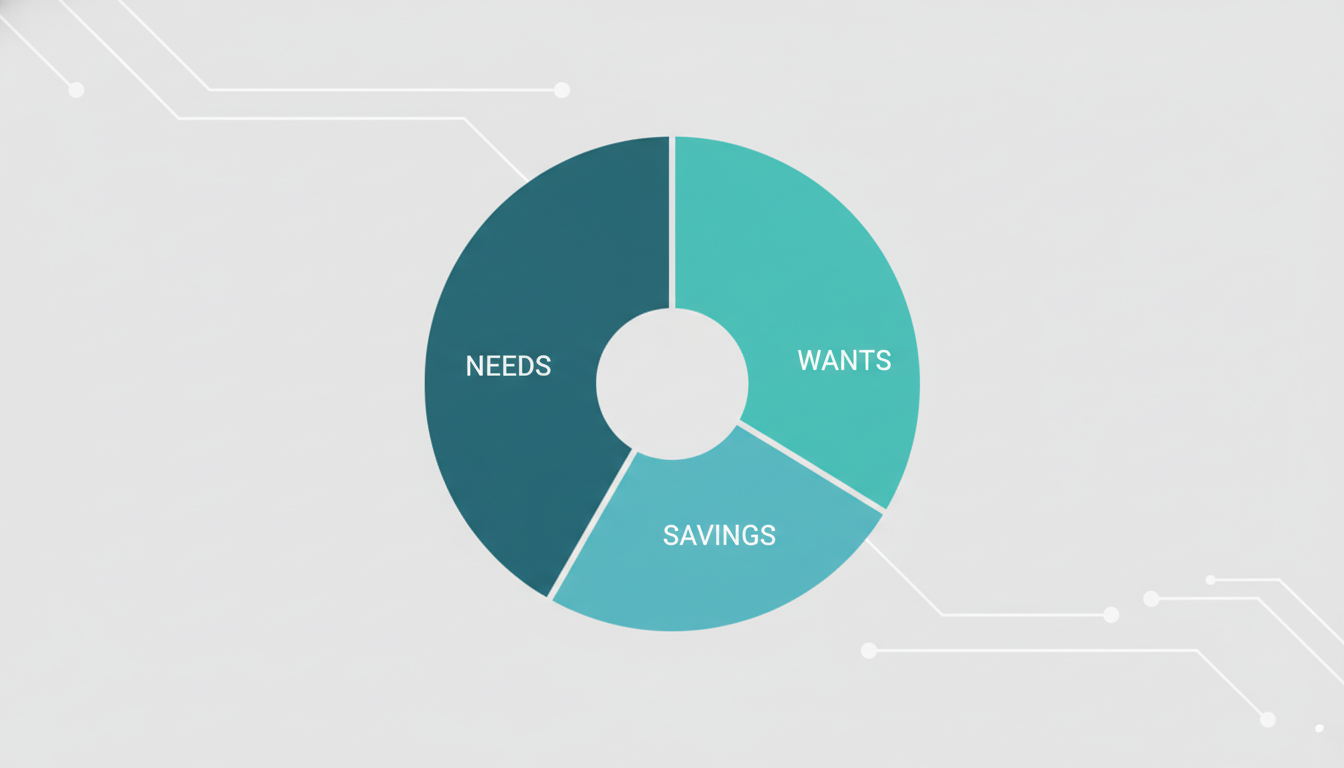
That statistic is not about income — it is about the lack of a plan. The 50 30 20 budget rule gives you that plan. It takes your take-home pay and divides it into three clear, simple buckets so every dollar has a job before you spend it.
Think of it as the financial GPS your bank account never came with. Instead of guessing where your money went, you decide in advance exactly where it goes.

The Data Behind the 50 30 20 Budget Rule
The 50 30 20 budget rule was popularized by U.S. Senator Elizabeth Warren and her daughter Amelia Warren Tyagi in their book All Your Worth: The Ultimate Lifetime Money Plan. The framework was designed specifically to be simple enough for anyone to follow without a finance degree.
Financial experts at NerdWallet and Investopedia both endorse the 50 30 20 budget rule as an ideal starting framework for beginners. Its strength lies in flexibility — it does not tell you which restaurant to skip or which subscription to cancel. It tells you how much room you have in each category and lets you decide how to fill it.
Here is what the research and real-world data tells us about budgeting behavior:
- Most people underestimate their wants spending: Studies show the average American spends roughly 33% of income on discretionary wants, slightly above the 30% target — meaning small adjustments go a long way.
- Savings rates are dangerously low: The U.S. personal savings rate hovered around 3–5% in recent years, far below the 20% the rule recommends. Even hitting 10% would double what most people currently save.
- Debt payoff is included in the 20%: Many beginners do not realize that paying off high-interest debt like credit cards counts as part of your savings bucket — which makes the 20% target feel far more achievable.
- Automatic budgeting increases success: People who pre-allocate income before spending are significantly more likely to stick to a budget, according to behavioral finance research. The 50 30 20 budget rule creates that pre-allocation by design.
One common myth worth busting: budgeting means depriving yourself. The 50 30 20 budget rule actually gives 30% of your income to wants — guilt free. That is permission built right into the system.
Another data point worth knowing: using a 50 30 20 budget rule calculator or a 50 30 20 rule spreadsheet can cut the setup time to under 15 minutes. You do not need expensive software — a free Google Sheet works perfectly.
Step-by-Step 50 30 20 Budget Rule Guide
How to Apply the 50 30 20 Budget Rule to Your Own Income
Here is exactly how to implement the 50 30 20 budget rule from scratch, with real numbers so nothing feels abstract. Follow these five steps and you will have a working budget by the end of the day.
Step 1: Find Your True Take-Home Pay
Pull up your most recent pay stub and look for your net pay — the amount deposited into your bank after taxes, Social Security, and any other deductions. This is your starting number. Do not use your gross (pre-tax) salary, a mistake covered in detail in the next section.
For this example, let us say your monthly take-home pay is $4,000. Every percentage below is calculated from this number.
Step 2: Calculate Your 50% Needs Budget — $2,000
Multiply your take-home pay by 0.50. On $4,000, that equals $2,000 for needs. Needs are expenses you genuinely cannot avoid — not just things that feel necessary.
- Rent or mortgage: Your housing payment, including renters insurance.
- Groceries: Food bought at the store for home cooking — not takeout or delivery.
- Utilities: Electricity, gas, water, and internet if required for work.
- Transportation: Car payment, insurance, fuel, or a transit pass to get to work.
- Minimum debt payments: The minimum required payment on student loans or credit cards.
- Health insurance and prescriptions: Non-negotiable medical costs.
If your needs exceed $2,000 on a $4,000 income, it is a signal — not a failure. It means you may need to address a fixed expense like rent before the rest of the budget can balance.
Step 3: Calculate Your 30% Wants Budget — $1,200
Multiply your take-home pay by 0.30. On $4,000, that is $1,200 for wants. Wants are everything that improves your life but is not strictly required for survival or work.
- Dining out and coffee shops: Restaurants, fast food, and your daily latte habit.
- Streaming subscriptions: Netflix, Spotify, Hulu, and any other entertainment service.
- Hobbies and recreation: Gym memberships, gaming, sports leagues, and concerts.
- Travel and vacations: Flights, hotels, and weekend trips.
- Shopping: Clothing beyond the basics, home décor, and gadgets.
The honest test: if you lost your job tomorrow, would you cancel it immediately? If yes, it is likely a want, not a need.
Step 4: Calculate Your 20% Savings and Debt Payoff — $800
Multiply your take-home pay by 0.20. On $4,000, that is $800 per month going toward your financial future. This bucket has three priorities, in order:
- Emergency fund first: Build three to six months of expenses in a high-yield savings account before anything else. That is roughly $6,000–$12,000 for most people on this income.
- High-interest debt second: Once your emergency fund has a starter balance of $1,000, attack any debt above 7% interest — especially credit cards charging 20–29% APR.
- Long-term investing third: Open a Roth IRA or contribute to your employer's 401(k). If your employer matches contributions, capture every penny of that match — it is an instant 50–100% return on your money. Our guide to Roth IRA for Beginners walks you through exactly how to get started.
Step 5: Audit Your Last 30 Days
Open your bank and credit card statements from the past month. Total every transaction and sort each one into needs, wants, or savings. This is the most revealing step — most people discover their wants have been eating into their savings without them realizing it.
You can do this with a free 50 30 20 rule spreadsheet on Google Sheets or use a 50/30/20 rule calculator monthly tool on sites like NerdWallet to speed up the math. The goal is not to feel guilty about last month — it is to get an honest baseline so this month can be different.
50 30 20 Budget Rule Mistakes to Avoid
Even a simple system like the 50 30 20 budget rule has traps that trip up beginners. Knowing these in advance saves you weeks of frustration and keeps your budget from feeling broken when it is actually just misconfigured.
Mistake 1: Using Gross Income Instead of Net Pay
This is the single most common error with the 50 30 20 budget rule. If you earn $60,000 per year gross, your take-home pay after federal taxes, state taxes, and Social Security is closer to $45,000–$48,000 — meaning your monthly net is roughly $3,750, not $5,000.
Running the percentages on $5,000 instead of $3,750 inflates every bucket by hundreds of dollars. Your wants budget looks like $1,500 when it should be $1,125. Always, always use your actual deposit amount.
Mistake 2: Misclassifying Wants as Needs
Cable TV, a premium gym, or streaming bundles feel essential — but they are wants. Misclassifying them inflates your 50% bucket and leaves you wondering why there is nothing left for savings.
A useful rule: needs keep you employed, housed, fed, and healthy. Everything else is a want, no matter how long you have had it or how much you enjoy it.
Mistake 3: Skipping the Emergency Fund
Many beginners jump straight to investing their 20% without building an emergency fund first. Then a $700 car repair hits and they raid their investment account — often triggering taxes and penalties that cost more than the repair itself.
Build at least $1,000 in liquid savings before investing a single dollar. It sounds boring, but it is the move that keeps every other part of the 50 30 20 budget rule intact when life happens.
Mistake 4: Treating the Percentages as Rigid Rules
The 50 30 20 budget rule is a framework, not a law. If you live in San Francisco or New York where rent alone can consume 40–50% of take-home pay, adjusting to 60/20/20 or 65/15/20 temporarily is completely valid.
According to discussions on 50 30 20 budget rule Reddit threads, many users successfully adapt the percentages to their cost-of-living reality while keeping the core principle — every dollar is intentionally assigned — completely intact.
The goal is progress, not perfection. A slightly modified version you actually follow beats a textbook version you abandon in week two.
Start Your 50 30 20 Budget Rule Journey Today
You do not need a financial planner, a fancy app, or a perfect credit score to start the 50 30 20 budget rule right now. You need one thing: your last bank statement and about 20 minutes.
Here is your action plan for today:
- Open your banking app or log into your bank online.
- Find your most recent paycheck deposit — that is your monthly take-home pay.
- Multiply it by 0.50, 0.30, and 0.20 to get your three budget targets.
- Scroll through last month's transactions and tag each one as a need, want, or savings.
- Compare your actual spending to your targets and identify the one category that is most out of balance.
- Make one specific change this week — not ten — to bring that category closer to its target.
That is it. One statement, three buckets, one change. The 50 30 20 budget rule works precisely because it is this simple. According to Investopedia's breakdown of the 50/30/20 rule, its simplicity is the very reason it outperforms complex budgeting systems for most people — especially beginners.
As your income grows, the math scales automatically. A $6,000 take-home means $3,000 for needs, $1,800 for wants, and $1,200 toward savings every single month. The system grows with you.
Ready to keep building your financial foundation? Explore more financial articles on TipForFunds for guides on investing, saving, and earning more — all written for real people, not finance professors.

Frequently Asked Questions
How effective is the 50/30/20 budget rule?
The 50 30 20 budget rule is widely regarded as one of the most effective budgeting frameworks for beginners because of its simplicity and built-in flexibility. It does not require tracking every small purchase obsessively — just three categories — which dramatically improves the odds that you will actually stick with it long-term. Financial experts at NerdWallet and the Consumer Financial Protection Bureau recommend it as an excellent starting point for anyone who has never budgeted before.
What is the 70-10-10-10 budget rule?
The 70-10-10-10 rule is an alternative budgeting framework that divides your income into four buckets: 70% for living expenses (needs and wants combined), 10% for savings, 10% for investing, and 10% for giving or tithing. It is a slightly more detailed approach than the 50 30 20 budget rule and is popular among people who prioritize charitable giving as part of their financial plan. Both methods share the same core philosophy — every dollar should be intentionally assigned before you spend it.
What is the 3 6 9 rule of money?
The 3-6-9 rule of money is a savings milestone guideline suggesting you aim to have three months of expenses saved by your late 20s, six months saved by your mid-30s, and nine months saved by your early 40s. It is more of a long-term savings benchmark than a monthly budgeting system like the 50 30 20 budget rule, but the two work very well together. Using the 20% savings bucket from the 50 30 20 budget rule is one of the most reliable ways to hit each 3-6-9 milestone on schedule.
At what age should you have $100,000 saved?
Many financial planners suggest having $100,000 saved by age 30, though this benchmark varies widely depending on income, cost of living, and when you started working. The key factor is not the exact age but the habit of consistently saving — which is exactly what the 20% bucket in the 50 30 20 budget rule is designed to build. Someone earning $4,000 per month who saves $800 consistently would accumulate $100,000 in roughly 10 years, not accounting for investment growth that could get them there significantly faster.
Disclaimer: This article is for informational purposes only and does not constitute financial advice. Always consult a qualified financial advisor before making investment decisions.